Social Listening

You don't have ten minutes to comb LinkedIn before every call.

Label a stakeholder in Kandir and Social Listening goes to work immediately — continuously watching for comments, reactions, shares, job changes, and public commentary. The moment something surfaces, it lands in your signal feed and on the account plan, right where you're already building the strategy. Not a search you have to remember to run.
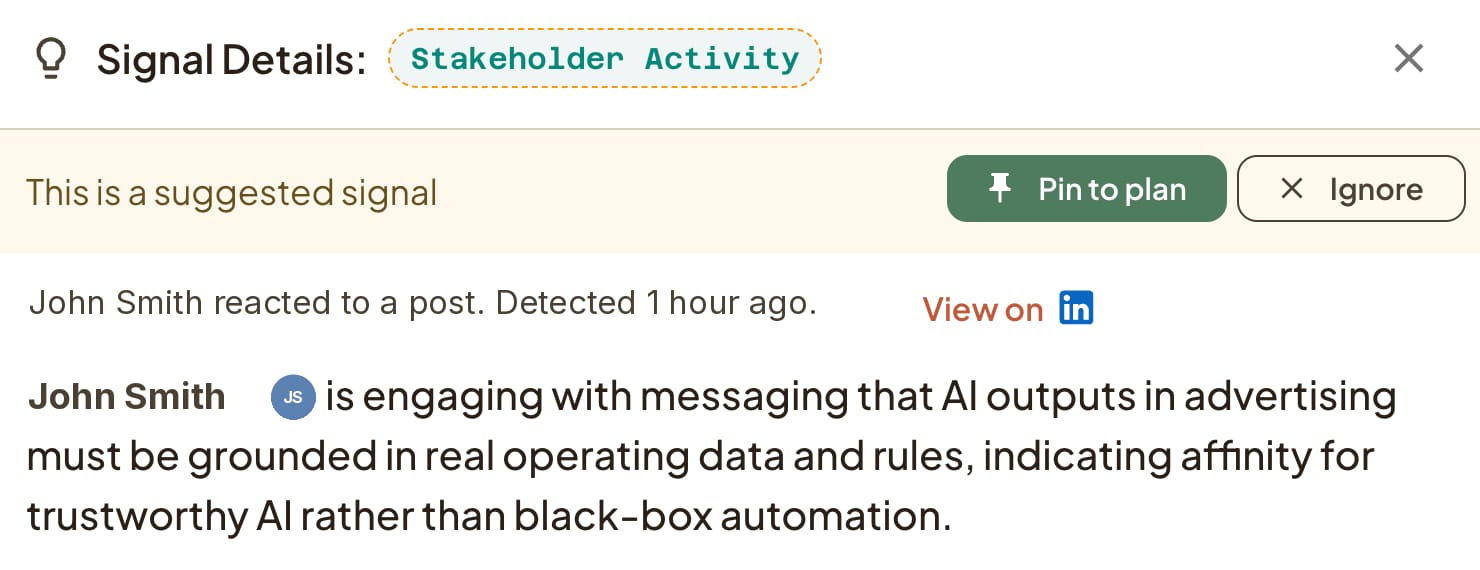
A Stakeholder Activity signal in Kandir: John Smith reacted to a post, detected 1 hour ago, with a link to view it on LinkedIn and an explanation that he is engaging with messaging that AI outputs in advertising must be grounded in real operating data and rules — indicating affinity for trustworthy AI over black-box automation.

Label a stakeholder. That's the entire setup.

There's no watchlist to build, no keyword to tune, no alert to configure. The moment a person is labeled a stakeholder on one of your accounts, Kandir starts listening to them — and keeps listening, across every account, every day, whether or not you have a call on the calendar. The work you already do to map an account is the work that turns listening on.

What Kandir listens for
Comments
What they say on other people's posts — usually more candid than their own.
Reactions
What they endorse without writing anything. A quiet, honest signal.
Shares
What they want their own network to see. Priorities, in public.
Job changes
New title, new scope, new budget — or your champion walking out the door.
Public commentary
Panels, podcasts, posts, press. What they're on record caring about.
Nothing to switch on. If they're labeled, they're being watched.

Fresh, or it isn't intel.

A stakeholder's post from six weeks ago isn't a conversation starter — it's an awkward one. By the time you find it, the moment has passed, and bringing it up says you weren't paying attention when it mattered. Kandir surfaces the activity in hours, not after the fact. Early enough that referencing it reads as attentive instead of archaeological.

The same signal, found two ways
Ten minutes before the call
You scroll their profile, find a post from five weeks ago, and decide it's too old to mention. Or you skip the research entirely — the calendar was too full.
→ You walk in with nothing.
With Social Listening
It was in your feed the same day, with what it implies about how they think — waiting on the account plan when you opened it.
→ You open with what they care about.

It arrives where you're already working.

Another notification stream is another thing to ignore. Stakeholder activity lands in the same signal feed as everything else Kandir watches, and on the account plan for the account that person belongs to — attached to the strategy you're already building, next to the org chart they're already on. You don't go looking for it. It's there when you open the plan.

Where a stakeholder signal shows up
Signal feed
In line with funding, competitor, and org signals — scored against the accounts and offerings it touches.
Account plan
Pinned to the plan for that person's account, so it's in front of you while you're working the strategy.
The contact record
Accumulating on the stakeholder themselves — what they've said over time, not just the latest post.
Zero extra steps. No new tab, no new tool, no new habit.

Signal should find you. Not the other way around.

This is the principle behind everything in Kandir, and Social Listening is the sharpest version of it yet. It's always on, it's narrowed to the people who actually matter on your accounts, and it asks nothing of you once a stakeholder is labeled. The more of your buying committee you map, the more of it Kandir watches — and the fewer moments to sell, expand, or save a deal go by without anyone noticing.

What you stop losing
The promotion you found out about in month three
A new title is new scope and a new budget. The window is ninety days.
The post your competitor replied to first
They were listening. Reacting late to stakeholder news is how ground gets ceded.
The opinion that reframed the whole pitch
They told the internet exactly how they'd evaluate you. Nobody read it.

Stop finding out
three weeks late.